Saturday, June 3, 2017

Thanks U.S., China, Philippines, Australia, Belgium, Russian, and Turkmenistan!

Thank you all in the U.S, China, the Philippines, Australia, Belgium, Russian, and Turkmenistan for looking at this blog!  People in the U.S. often say others, such as France, should be grateful to us for the aid our country has rendered.  But let's not forget the aid other countries have rendered us.  France helped the U.S. break free of Britain.  Russia supported the U.S. during the Civil War and shed the preponderance of blood in WWII.

But let's face it.  There is no gratitude in international affairs.  Naked self-interest rules.  So expecting gratitude is a waste of time and probably a harmful delusion..

Illustrate as You Go

I got the manuscript of my history of the 12th Virginia Infantry, the Petersburg Regiment, off to SavasBeatie last weekend.  Since then I've been reacquainting myself with what I've written about June 18-22, 1864, at the Cockade City.  I've found that as I reacquaint myself with the material, it's convenient to illustrate the chapters.  Finding Federal illustrations is much easier than finding Confederate illustrations!

Sunday, May 21, 2017

The Petersburg Canon, Part IX: Missing Histories

Now comes a big gap in the history of the Siege of Petersburg, covered only by the general histories of the siege, not by any more detailed studies than perhaps a magazine article.

First, there is the Applejack Raid, also known as the Stony Creek Raid or the Weldon Railroad Raid, of December 7-12, 1864.  Grant sent a reinforced corps to wreck the Weldon Railroad from Stony Creek to Hicksford.  Lee dispatched A. P. Hill with infantry and Hampton with cavalry in pursuit.  Little fighting resulted, but there will always be speculation about what might have happened if Hill had adopted Mahone's plan to send half the infantry to Jarratt's Station to cut off Warren's retreat.  The destruction of a reinforced Federal corps might not have amounted to a Saratoga at this point, with the presidential election over.  A history of the Applejack Raid must also focus on the impact of the raid upon civilians.  It must draw upon many individual accounts.

Next, there is the naval Battle of Trent's Reach, January 23-25, 1865.  This affair was probably connected with the march of Mahone's Division to Belfield at the same time.  The Confederate James River Squadron sortied in the absence of almost the entire Federal fleet, which had gone to assist in the capture of Fort Fisher.  The mission was to bombard City Point, something that brings to mind Kongo and Haruna bombarding Henderson Field on the night of October 13, 1942.  The Confederate ironclads did not make it to City Point.  Though Virginia II and Richmond grounded, Fredericksburg made it through, frightened off the double-turreted monitor Onondaga, and then--turned back!  Never Send an Admiral on a Suicide Mission would be my title.  When fatigue sets in, sailors revert to their default mode--save the ship.  Look at Admiral Mikawa after Savo Island and Admiral Kurita at Leyte Gulf--charged with destroying the American transports, both turned back to save their ships after destroying everything in their way.  There was no point in saving their ships.

Finally, there is the Battle of Hatchers Run, February 5-7, 1865.  This was Grant's eighth offensive at Petersburg, with most of the Army of the Potomac fighting it out in terrible weather with elements of Lee's Second and Third Corps.  The offensive appears linked with the Hampton Roads Conference, where the Confederates tried unsuccessfully to negotiate a peace on terms better than unconditional surrender.  There will be many Federal regimental histories to draw upon and to get a balanced view, the author will have to do a lot of research into Confederate manuscripts and newspapers.

Back Up Those Files!

On Friday afternoon, just as I was putting the finishing touches on the manuscript of The Petersburg Regiment, 12th Virginia Infantry:  A History, an unsolicited download from Microsoft wiped the entire manuscript and all my legal work from my laptop.

Thank God for Carbonite!  By Friday evening, everything was back.  I had my files backed up otherwise, but not as well.

I'm not plugging a specific product, but two good friends have lost substantial work for want of back-up.  Get those files backed up!

Saturday, May 6, 2017

Addendum to The Petersburg Canon, Part 1: Histories Dealing with the Entire Campaign

Originally, in Part 1 of the Petersburg Canon, I mentioned three general campaign histories and two two-volume works dealing with the campaign Southside.

There is a substantial work on the fighting on the York-James Peninsula--The Peninsula.  This is volume 2 of Henrico County, Field of Honor, written by Louis Manarin and published by Henrico County.  (Volume 1 covers the fighting in 1862, volume 2 the fighting in 1864.)  I disagree with many of the opinions expressed in volume 2 about the fighting in August 1864, but it is possible that the author may be right about them and I may be wrong.  The production values in this book are unparalleled--glossy paper, color photographs and color maps.  Furthermore, it fills a gap in the canon by covering virtually all the fighting on The Peninsula during the Siege.  It is unusually expensive, but it belongs on the shelf of every Siege of Petersburg aficionado who can afford it. 

Saturday, April 29, 2017

Addendum to The Petersburg Canon, Part VI: Grant's Fourth Offensive--the Weldon Railroad, August 1864

Another thing I would do if I had it to do over again writing The Siege of Petersburg:  The Battles for the Weldon Railroad, August 1864, is to illustrate the book more methodically--not just with more maps, but with more photos and drawings.  As I illustrate The Petersburg Regiment, 12th Virginia Infantry, I've come across some helpful websites for illustrations.  There is http://www.petersburgproject.org/, where I found the following drawing of the Gurley House from the Diary of Francis W. Knowles:


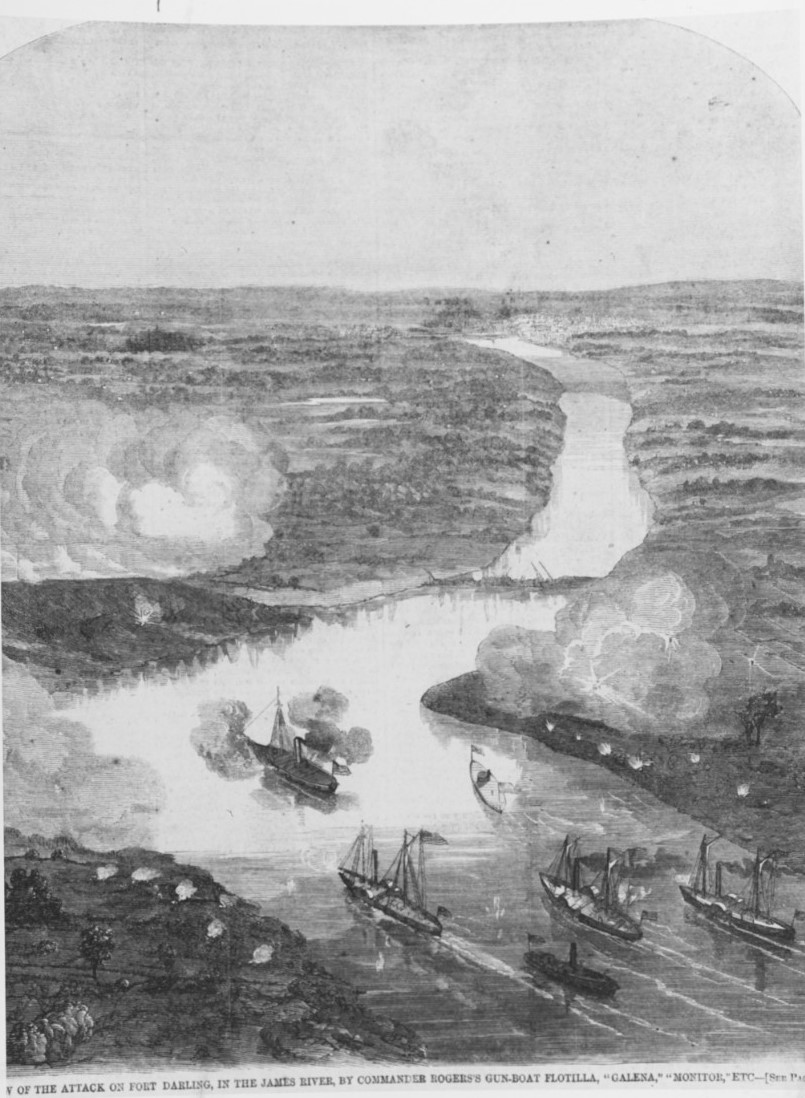
There is https://www.history.navy.mil/, where I found helpful pictures of ships and naval actions (the ship is USS Thomas Freeborn and the action is First Drewry's Bluff):


There are also websites for Harper's Weekly, Frank Leslie's Illustrated History of the Civil War, and Battles and Leaders of the Civil War.  These are so easy to find that you just have to put those titles in your search engine to come up with the websites.  The Library of Congress and the National Archives are also readily available, as is the U. S. Army Heritage and Education Center.  

Tuesday, April 25, 2017

The Petersburg Canon, Part VIII: Grant's Sixth Offensive, October 1864

The third of the three consecutive books on the Siege of Petersburg that each cover one of Grant’s offensives is Richmond Must Fall, by Hampton Newsome.  This book covers Grant’s sixth offensive at Petersburg, and indeed a little more—some of the aftermath of Grant’s fifth offensive.  Hampton captures unforgettably the dismal atmosphere of late October 1864.  He provides us with detailed accounts of the fighting on October 7, October 13, and—most importantly—October 27, 1864, Grant’s last grasp at Richmond before the November election.  The maps he has drawn are excellent.  His opinions are judicious.  Richmond Must Fall belongs on the shelf of every student of the Siege of Petersburg.  I only wish he had allowed me to be of more help to him, though I doubt I could have been as much help to him as he has been to me.  Hampton drew the maps for my book The Siege of Petersburg:  The Battles for the Weldon Railroad, August 1864.  He has drawn the maps and diagrams for my next book, on the 12th Virginia Infantry, which fought at Burgess Mill south of the Appomattox on October 27.  He read the manuscripts of both these books and provided very sensible editorial advice—he’s an outstanding editor as well as a masterful writer.  I hope I have not diverted him too much from his own work—his next project is a book about the Confederate counteroffensive on the North Carolina coast in the spring of 1864.  He really knows his stuff about the Siege of Petersburg, because he took the lead in editing (with John Selby and myself) Civil War Talks:  Further Reminiscences of George S. Bernard and His Fellow Veterans (2012), possibly the most important book on the siege since Bernard’s War Talks of Confederate Veterans (1892).