Thursday, May 12, 2022

12th Virginia Calendar: May 12, 1864, Spotsylvania, Heth's Salient, Pvt. Leonidas H. Dean Captures 51st Pennsylvania Infantry's Flag


Escaping from the Fire in the Woods--"Wilderness" by Alfred Rudolph Waud

Library of Congress

Ambulance Corps men had to be the bravest of the brave.  They had to pick up the wounded under fire, lest the unwounded become demoralized.  Pvt. Leonidas H. Dean of the 12th's Company B, the Petersburg Old Grays, a member of the ambulance corps, had distinguished himself on May 6, 1864 in the Wilderness, dragging many wounded Yankees out of the burning woods, but he could not rescue them all.  Some perished in the flames.


Flag of the 51st Pennsylvania Infantry

On May 12, east of Heth's Salient at Spotsylvania, Weisiger's brigade of Mahone's division and Lane's brigade of Cadmus Wilcox's division engaged Orlando Willcox's division and Federal batteries.  Weisiger's brigade and Lane's brigade captured flags and prisoners in an enormous melee.  Dean grabbed a musket and captured a beautiful stand of colors from the 51st Pennsylvania Infantry along with eight Keystoners.[1]  During the following months Dean would continue to distinguish himself and justify being named after the Spartan king who perished at Thermopylae.


Map by Hampton Newsome


[1] OR 36, 3:802; Statement of Napoleon Bonaparte Simmons, Notes of St. George Tucker Coalter Bryan; John Horn, The Petersburg Regiment in the Civil War: A History of the 12th Virginia Infantry from John Brown's Hanging to Appomattox, 1859-1865 (Savas Beatie, 2019), Winner of the 2019 Army Historical Foundation Distinguished Writing Award for Unit History, 232, 249.


Tuesday, May 10, 2022

The Irony of Winslow Homer's "Prisoners from the Front" (1866)

Winslow Homer, a Special Artist for "Harper's Weekly" magazine, accompanied Brig. Gen. Francis Channing Barlow on his reconnaissance toward the Weldon Railroad south of Petersburg on June 21, 1864.  This was at the beginning of the battle of Jerusalem Plank Road, a Federal disaster during the first attempt to envelop the Cockade City from the plank road to the Appomattox above the city.  Barlow, a Harvard educated New York lawyer, was a brave soldier but an unlucky general wounded at Antietam and Gettysburg.   He was ambushed about a mile short of the tracks by Brig. Gen Rufus Clay Barringer, who had studied law with his brother in North Carolina after graduating from the University of North Carolina.  Barringer, nicknamed "Aunt Nancy," repulsed Barlow.

After the war, Homer drew on his sketches of the period to paint "Prisoners from the Front", in 1866.  This painting established his reputation.

There follow excerpts on the June 21, 1864 fight from my forthcoming book on Lt. Gen. Ulysses S. Grant's second offensive at Petersburg.


Winslow Homer, Prisoners from the Front (1866), Metropolitan Museum of Art

***

After the United States Army had crossed the James, it failed to take Petersburg by assault.  On the morning of June 21, 1864, the army set out to invest Petersburg from the army’s left on Jerusalem Plank Road to the Appomattox River above the city.  II Corps, the army’s crack formation, led the way.

The corps moved out from the Avery house with Barlow’s division in the van.  Troops of II Corps units prior to the March 23, 1864 consolidation of II Corps with the former III Corps wore as their insignia a club or clover, with a different color for each division.  Barlow’s division wore a red club.  Inadvertently left on the fog-covered picket line until five that morning, Pvt. William Horton of the 26th Michigan in Miles’ brigade of the Red Club Division began the hike with little sleep.  “We come up with the regt about 8 o’clock,” he recorded.  “We eat our Breakfast and lay Down for a little rest.  We are routed up and ordered to march….”  Major General David Bell Birney, an Alabama-born Philadelphia lawyer, led the corps that day because Maj. Gen. Winfield Scott Hancock was suffering from his Gettysburg wound.  At 10 a.m., Birney ordered Mott's division back at the Avery house to dispatch the 2nd United States Sharpshooters to lead the column of Barlow’s division.  Shortly after 10 a.m., Barlow's division crossed the Norfolk & Petersburg Railroad near the deserted, white Southwell house while V Corps moved its left up to Jerusalem Plank Road south of the Dimmock Line. 

Gibbon’s division departed the Avery house next.  Mott’s division left the Avery house last.  Shortly afterward, Lt. Col. Theodore Lyman III, who had studied at Harvard before joining Meade’s staff as archivist, fell in with the men of Mott’s division as they plodded along the road past the Southwell house.  Major General George Gordon Meade, the commander of the Army of the Potomac, had sent Lyman to accompany II Corps and report on its progress.  “The road was narrow and full of troops, and led by several clearings where young corn was growing—small, it seemed to me for the season,” Lyman recalled.  The column marched through a gently undulating landscape of fields and woods, affording little opportunity for the employment of artillery and parched by the sun.  “The weather is very hot, and we cannot procure anything to drink but warm, muddy water, made so by men, mules and horses all rushing into it,” Second Lieutenant George Augustus Armes of the corps staff remembered.  “Canteens and tin cups by the hundreds can be seen by the side of a mule's or horse's front or hind leg or nose in the water, and other men hurrying out of their way, so as to dip their caps in and drink, as if the water was from a nice cool spring.”

***

About noon on June 21, Barlow’s division reached a wide road—Jerusalem Plank Road--at right angles to the division’s march route.  To the left lay a big cornfield and a large white wooden house with several dependencies, deserted by the Williams family, which had fled to Petersburg taking their furniture but leaving some slaves, some cows and, most importantly to Lyman, some ice. 

At the plank road, the Red Club Division encountered videttes from Barringer’s North Carolina Cavalry Brigade of William Henry Fitzhugh “Rooney” Lee’s division. The videttes came from picket posts about a mile east of the Weldon Railroad for the first few miles south of Petersburg.  Troopers of the 3rd North Carolina of Barringer’s brigade manned the picket posts.  The body of the 3rd encamped by the railway near the Davis house about five miles south of Petersburg.  The rest of Barringer’s brigade tented by the railroad near Globe Tavern, just over a mile farther south.  Dearing’s brigade of Local Defense Troops, horsemen temporarily assigned to Rooney Lee’s division, picketed the railroad still farther southward, to the vicinity of Reams Station, about 12 miles south of the Cockade City.  Both Confederate brigades had orders to drive off any raiding party attempting to damage the railway.  

Birney had to make a choice when he reached the plank road.  His orders left him with some discretion.  He could extend as far to the left as practicable, hopefully to the Weldon Railroad, and then close up to the Confederate line as closely as possible.  Or he could close up to the Secessionist line as closely as possible, and then extend as far to the left as practicable, hopefully to the Weldon Railroad.  Birney explored the first option, sending Barlow’s division alone toward the railroad and holding back Gibbon’s and Mott’s divisions near the Williams house.  

Barlow’s division crossed the plank road and slowly advanced along the lane beyond the Williams farm throwing up rifle pits during pauses.  Crowninshield’s detachment of Bryan’s ad hoc cavalry brigade led, supported by Miles’ brigade.   Bryan’s brigade consisted of the 1st Massachusetts, the 3rd New Jersey and the 18th Pennsylvania.  Brigadier General Nelson Appleton Miles, a former crockery store clerk wounded at Chancellorsville, deployed as skirmishers the 61st New York, the Clinton Guards, to the right of the lane, and the 81st Pennsylvania to the lane’s left. 

The 3rd North Carolina’s videttes resisted the advance of Barlow’s division.  “The firing began to grow very lively as soon as we reached the Jerusalem plank road, where we were obliged to halt, and feel our way slowly, and fortify as we advanced,” remembered Lieutenant Armes.  Soon the lane entered woods near the Browder farm, and wounded began to come in, some walking and others on stretchers.  Companies H and K of the 116th Pennsylvania in Moroney’s brigade skirmished on the flank of Barlow’s column.  “I shot at a reb cavalry man I thought I had killed him, I went down and found the Johnnie gone, but I found where he had been the most beautiful double barreled shot gun I ever seen,” noted First Sgt. Samuel A. Clear of Company K.  “I kept it a while and then I had to lay it down in the woods and leave it lay.  I would have given fifty dollars to of had it sent home.”  

On the Browder farm, Barlow’s division reached a fork in the lane and took the track leading first to the left and then northwestward past the Aiken farm toward the 3rd North Carolina’s picket post on the Risdon farm.  By 12:55 p.m., the divisions of Gibbon and Mott had reached the Williams farm and were massing there.  They could still either support support the Red Club Division if it ran into trouble or head northward to take position on the right of V Corps.  At about 1 p.m., a contraband informed Brig. Gen. Francis Channing Barlow that his division had arrived within two and a half miles of the railway.  “The cavalry report the enemy in force and have had a little firing,” reported Barlow.  “It is nothing.”  

Brigadier General Francis Channing Barlow (Library of Congress)

***

             Meanwhile, the 2nd United States Sharpshooters was still hustling from Mott’s division at the rear of Birney’s column to Barlow’s division at its head.  The marksmen had started off almost at the double quick.  As they hurried along, they left behind First Sgt. Wyman Silas White of Company F, one of the regiment’s New Hampshire companies. 

Infantrymen were marching abreast of the sharpshooters on the other side of a high fence in the slightly rolling fields, interspersed with woods, streams and swamps.  White had lost his rifle’s tompion, a wooden plug designed to keep the water out of the rifle barrel.  As he hastened along, he noticed an infantryman’s tompion just hanging in the muzzle of his rifle.  “I called Captain [Samuel F.] Murry’s attention to it and told him that when the [tompion] dropped, I was going to get it,” remembered White.  “I climbed over the high fence and had just gotten over when the coveted [tompion] hit a fence stake and fell to the ground.”  Picking up the tompion, White walked along the fence hoping to find a place with the boards down so that he could get back into the road without climbing over the fence again.

White found such a place near a fork in the road.  He discovered that his regiment had outmarched him and gotten out of sight.  He could not tell which road his comrades had taken.  “I took the right hand road for it led more towards the enemy’s lines and I heard firing in that direction,” White remembered.  “I knew General Barlow had borrowed our regiment to do skirmishing where he was intending to attack the enemy.”  White hurried on expecting to overtake his regiment, passing infantrymen who were forming a line at right angles to the road.  Expecting to strike his regiment deployed in a skirmish line, he followed the road until he reached a curve.  Two or three hundred feet ahead, he saw a Rebel picket post.  “There were three of them around a small fire right in the road and they were doing some cooking for there was no other use of a fire that hot June day,” he recalled.  “They did not see me at all.”

White turned and put as much distance as he could between the Southerners and himself.  “The firing became quite brisk at that time,” White remembered.  

***

Shortly before 3 p.m., “what was left of the Regt…were placed in the advance, as advance guard,” recalled Pvt. William B. Greene, a former student in New Hampshire in the 2nd United States Sharpshooters’ Company G.  “The men were nearly played out with fast marching but no rest was granted them.”  Barlow employed the sharpshooters, known as Green Coats because of their uniforms, to replace the cavalry, which he considered useless.  Lieutenant Colonel Homer Richard Stoughton, a Vermonter and former railroad man wounded at Po River that May, had just rejoined the 2nd and assumed its command that morning.  The landscape the sharpshooters threaded their way through, remembered First Lt. Charles A. Stevens, “was covered with deep woods, tangled brush, creeks and swamps, making the movement tedious and unsatisfactory.”  The marksmen soon pushed the sentinels of the 3rd North Carolina back from their picket post on the Risdon farm.

***


Brigadier General Rufus Clay Barringer (Library of Congress)

General Robert Edward Lee had written off the Weldon Railroad as indefensible because of its proximity to the Federal lines.  Despite his negative prognosis for the railroad, the advance of II Corps toward the tracks surprised the Confederates.  Brigadier General Rufus Clay Barringer, a lawyer known to his troops as “Aunt Nancy,” led the Tarheel cavalry brigade of Maj. Gen. William Henry Fitzhugh “Rooney” Lee’s cavalry division.   Captain John Marion Galloway of Company D in the 5th North Carolina Cavalry of Barringer’s brigade considered Barringer, “Brave enough, but of a prudent, methodical, cautious temperament.”  Another Tarheel trooper thought Barringer old and slow but a good officer.  

Barringer and his staff “had mounted and were only waiting for the Bugle to sound, the signal to march, when a courier dashed up at breathless speed from Col. John Algernon Baker, who, with his regiment, the 3rd, was on picket duty about three miles away, reporting that he was being hard pressed by the enemy and was in dire need of quick re-enforcements,” recalled First Lt. Fred C. Foard, recently appointed aide-de-camp to Barringer.  Aunt Nancy hurriedly formed his line.  “We were wholly without support, but the thick undergrowth and other surroundings favored a vigorous resistance in a dismounted fight,” Barringer recalled.        

                                                      Map by Hal Jespersen

The Tarheel, who had read law with his elder brother and suffered wounds at Brandy Station and Bristoe Station, prepared an ambush for Barlow, a Harvard-educated New York lawyer wounded at Antietam and Gettysburg who liked to wear a red flannel shirt and carry a cavalry sabre with which to swat skulkers.  Barringer had McGregor’s battery, the 2nd Stuart Light Horse Artillery, unlimber at a high yet screened spot near the Davis house on the railroad at the junction of Vaughan and Halifax Roads, about two and a half miles south of Petersburg.  Aunt Nancy kept the 5th North Carolina Cavalry in reserve behind the guns.  He dismounted the 1st and 2nd North Carolina Cavalry and formed two heavy skirmish lines.  The men 2nd formed the first line, concealed in the undergrowth on the eastern border of the Davis farm, about a quarter mile behind the 3rd North Carolina’s picket post and three quarters of a mile from the railroad.  The 2nd’s troopers received instructions not to fire until the Federals came within 100 yards of them.  Then these Tarheels would fire a single volley.  In the trees a short distance to the rear, Barringer’s first line would join the 1st North Carolina in his second line and they would make a stand along the lane that led to the railway round a half mile to the west.  When the Federals reached that defile in the timber, the four 3-inch rifles of McGregor’s battery would open fire.  

***

Soon after 3 p.m., having pushed back the pickets of the 3rd North Carolina Cavalry, the 2nd United States Sharpshooters arrived at the border of the Davis farm.  Stoughton “was marching along in his shirt sleeves singing I haven’t got long to stay etc.,” Greene recalled.  Dismounted troopers of the 2nd North Carolina in Barringer’s first skirmish line and fugitives from the 3rd who had fallen back to that line, hidden along both sides of the lane, poured a volley into the Green Coats.  Stoughton reacted immediately.  ‘When the volley came in he sung out to the boys to go over the fence and give it to them,” Greene remembered.  “Over the boys went and pitched into them & drove them in to their entrenchments near by.”  Stoughton sought support from the 111th New York’s Col. Clinton F. MacDougall, a former banker whose brigade had by this time deployed on the left of the lane while Miles’ brigade had shifted to the lane’s right.  The Vermonter told the New Yorker that the Rebels outnumbered the sharpshooters.

“Go on,” replied MacDougall, treating the Green Coats with the same contempt with which his division commander had treated Crowninshield’s cavalry, “there is nothing in your front.”  

Stoughton resumed his advance without support for his sharpshooters.  They soon struck the second line of Barringer’s skirmishers.  The Secessionists loosed another volley and McGregor’s guns opened.  Shells burst over the Red Club men following Stoughton’s troops.  In the 57th New York, one projectile killed three men and a second killed one and wounded others.                                                                         


Map by Hal Jespersen

Led by Colonel Baker and Lieutenant Foard, the Tarheels counterattacked.  The Green Coats faltered and fell back.  “Our boys met them but it was a dear old meet for they came right up near enough to use the bayonet,” Greene remembered.  Soon Companies A and B of the sharpshooters reported themselves in danger of capture because the Rebels were overlapping their line.  Stoughton directed his men to break for the rear on their respective flanks.  “Some of the boys run & in fact, most all of them,” recalled Greene.  The North Carolinians surged back across the Risdon farm and seized many prisoners from the Green Coats, including Stoughton, who remembered, “I heard what I supposed was support coming on mv left and rear, and in attempting to adjust and join the line, fell into the hands of the 2d N. C. cavalry, dismounted.”  

“The ground over which we…fought was wooded with dense undergrowth, the opposing lines were very close together, not more than 15 or 20 yards apart,” recalled Lieutenant Foard.  “Captain Henry Coleman of the 1st Regiment perceiving a field Officer mounted and close up to his line, dashed throught [sic] both skirmish lines, seizing his bridal rein and with the muzzle of his pistol against the Officer’s body, brought him in to our lines a prisoner,” recalled Foard.  

Rallying quickly near the captured picket post, the Union sharpshooters charged again.  Some of the men in the 2nd’s Company B, a mostly Michigan unit, captured Lieutenant Foard and Colonel Baker, a Harvard educated lawyer, near the Risdon barn.  The pair had had gotten too far ahead of their troops.  “In the surging of the battle back and forth, I suddenly found myself entirely surrounded by the enemy and was taken prisoner just at the close of the battle,” Foard recalled.

Fire from the dismounted Tarheels at short range cut down many Green Coats.  “The Federal officers dashed bravely forward and called upon their troops to follow,” remembered Pvt. Paul B. Means of the 5th North Carolina Cavalry’s Company F.  “But volley after volley thinned their ranks and they broke and fled.”  MacDougall deployed the 111th, 125th and the 126th New York in support of the Green Coats and the New Yorkers along with Miles’ brigade gradually drove the Confederates back toward the Davis farm. 

The Red Club commander considered his brush with the dismounted enemy cavalry “quite a skirmish.”  The Federals lost at least 20 killed and wounded.  Barringer lost five killed, 23 wounded, one wounded and captured, and eight more missing for a total of 37.  The contraband with Barlow’s column now informed the division commander that he had arrived within two miles of the railroad.  In fact, only about a mile separated the Federals from the tracks.  Barlow, believing his division isolated, slowed his advance and sought orders from his corps commander.   “It is for you to decide whether it is safe for us to advance so as to separate this division from farther from the rest of the corps,” Barlow wrote to Birney, who had established his headquarters at the Williams house.  “We cannot both advance and keep up connection with the rest of the corps.  Is General Gibbon close behind me, as I understood he was to be?”

Barlow’s message to Birney illuminated the problems now faced by the Federal high command in its attempt to sever the Weldon and Southside railroads and invest Petersburg to the Appomattox west of the city.  The commander of the Army of the Potomac was pushing piecemeal into unfamiliar territory with roughly half the troops contemplated by the Federal plan.  Birney could not connect with both the Weldon Railroad and V Corps.  Barlow could not both advance and connect with the rest of II Corps.  The only force otherwise available to extend Birney’s line or assist Barlow—Ricketts’ division of VI Corps—remained in reserve near the trenches which the other divisions of its corps occupied.

While Barlow’s courier rode toward Birney, White found his regiment.  “I was soon on the left hand road and came into an open field and there found my regiment, or what was left of it,” he recalled.  “I was lucky enough to escape being in the frazzle of a skirmish, all through the picking up of the lost [tompion].  I was pleased for I could have been of no use if I had been there and I might have been either killed, wounded or captured.  As it was, I was spared to fight another day.”

***

Around the time Barlow’s courier reached Birney, Meade rode up to the Williams house, where he found Birney and Lyman.  In light of the ambush Barlow had endured and the unforeseen distance between Jerusalem Plank Road and the Weldon Railroad, Meade authorized Birney to terminate Barlow’s reconnaissance toward the railway, swing all three divisions of II Corps into position on the left of V Corps, get as close as possible to the enemy’s line of fortifications, and extend as far to the left as practicable—which could be no farther than the Weldon Railroad even if the corps stretched westward in a single line, and could under no circumstances be to the Appomattox above Petersburg.  Meade ordered VI Corps to reinforce Birney with Ricketts’ division. 

Birney ordered Barlow to withdraw and directed Gibbon and Mott to move up beside V Corps.  Barlow would have to wait to join them until Ricketts’ division arrived to take the place of the Red Club Division, which withdrew by a more northerly route than on the way out and threw up another line of pits northwest of the Browder farm.  Ricketts’ division started moving out from its bivouac and was crossing the Norfolk & Petersburg and turning south on Jerusalem Plank Road by 4:40 p.m.  

*** 

The battle of Jerusalem Plank Road had begun inauspiciously for the Federals.  Without Barringer’s repulse of Barlow, the Northerners would have reached the Weldon Railroad on June 21.  Now the parried Federal thrust had alerted the Southerners to the danger to their right.  Subsequent attempts to turn it would encounter more resistance.

Barlow's repulse at Barringer's hands forfeited the element of surprise and insured that subsequent Federal attempts to reach the Weldon Railroad would meet with more formidable resistance.  The defiant attitude of one of the prisoners in Winslow Homer's painting may be the only indication that they had defeated Barlow, and not vice versa. 

Copyright John Horn 2022

Friday, April 8, 2022

Maturing Thoughts about Barlow's Skedaddle at Petersburg on June 22, 1864

"Let your literary compositions be kept from the public eye for nine years at least," said the Roman poet Horace before the birth of Christ.  The English poet Alexander Pope seconded that advice in his eighteenth century "Epistle to Dr. Arbuthnot."  For Horace and Pope, aging seems to have worked magic for literary compositions similar to aging for wine.

***

Time has improved my analysis of Barlow's Skedaddle at Petersburg on June 22, 1864.  The historian of Barlow's corps referred to this matter as "The Petersburg Affair."  Three brigades of Mahone's division routed seven brigades of II Corps, inflicting about 2,300 casualties (including around 1,700 prisoners) and capturing four guns.  I first wrote about it in The Petersburg Campaign: June 1864-April 1865 (1993).  I revised my account several times over the ensuing years while writing The Petersburg Regiment in the Civil War: A History of the 12th Virginia Infantry from John Brown's Hanging to Appomattox, 1859-1865 (Savas Beatie, 2019).  My first draft of a map for The Petersburg Regiment... soon after 1990 had Wilcox's division on the Bailey/Johnson/Johnston farm in the earthworks actually dug and occupied by most of Bushrod Johnson's division a short time after Brig. Gen. William Mahone routed the front line of II Corps.  My final draft of a map of Jerusalem Plank Road around a quarter of a century later, spruced up by Hampton Newsome, is basically accurate; its achievement is the representation of the two Federal lines as non-parallel. 


Map by Hampton Newsome

Time has also improved my understanding of the deployment of the three divisions of II Corps on the line Mahone rolled up on June 22.  Gibbon's division arrived mid-afternoon on June 21 and began digging in along the road it followed from the Williams and Browder farms past the Strong farm and into Jerusalem Plank Road at an acute angle just south of a branch of Blackwater Swamp.  Mott's division followed Gibbon's division up the same road that evening and deployed along the road on the left of Gibbon's division.  That night Barlow's division marched up the same road and took post along it west of the Strong house and on Mott's left.

At 3 a.m. June 22, Gibbon's division advanced a few hundred yards to earthworks prepared by its pioneers from the plank road north of the branch of Blackwater Swamp southwestward into the woods.  At about 4:50 a.m., Chaplin's and McAllister's brigades of Mott's division began moving up regiment by regiment to a line west of Gibbon's division and on a roughly east-west axis.  The other two brigades of Mott's division shifted to the right in the rear line of Federal works.

Barlow's division did not begin advancing to a position on the left of Mott's division in the front line until around noon.  First Fraser's brigade came up on roads cut through the woods by the division pioneers and deployed on the left of Mott's division along the same east-west axis.  Then about 1 p.m. Brig. Gen. Francis Channing Barlow brought up Moroney's brigade (The Irish Brigade) and posted it as a return at nearly right angles to Fraser's brigade.  Barlow advanced MacDougall's brigade at approximately 2 p.m. to extend the return. Barlow ordered up Miles' brigade about 3 p.m.  Miles' brigade had just left the rear II Corps line when Mahone struck, outflanking Barlow's return and precipitating Barlow's Skedaddle.

If Miles' brigade had been up and extending Barlow's return, Mahone's attack would probably have come to nothing.  Moroney's and MacDougall's brigades initially repulsed Sanders' and Wright's brigades.  Mahone then committed Weisiger's brigade, Mahone's old brigade, and outflanked MacDougall's brigade.

Initially, my attention focused on Barlow for the reason why it took so long to bring up all the brigades of his division.  Time and repetitive examination of the records cured me of that error.  I finally grasped that the deployment of the two brigades of Mott's division consumed most of the time between 4:50 a.m. and 3 p.m.  It did so because the two brigades of Mott's division deployed regiment by regiment (David H. King, A. Judson Gibbs and Jay A. Northrup, History of the Ninety-Third Regiment, New York Volunteer Infantry, 1861-1865 (Milwaukee, 1895), 99), and those two brigades had many regiments.  Barlow deployed his division by brigades, which consumed about half the time.  

So while I at first suspected that Barlow's delay deploying contributed to the disaster, I ultimately saw that he posted his division far more speedily than his neighbor, Mott.  Because Mott did not place his troops adjacent to Gibbon's division as Barlow posted his troops adjacent to Mott (this will appear in the map for my next book), one cannot blame Mott for the time involved in a regiment by regiment deployment.

Friday, March 11, 2022

Some Maps of the U. S. Army's Positions on Jerusalem Plank Road, June 21-22, 1864

Mapping the movements of the Federal II Corps between the repulse of Barlow's division by Barringer's North Carolina cavalry brigade on June 21 and the end of II Corps' counterattacks to recover its lost guns and lines on June 22 is proving one of the most difficult tasks I have ever faced even with the help of a lifelong student of the battle such as Don Lauter, who has studied the fight for 50 years.  (I'm a newcomer, having studied the struggle for only about 30.)

There are a number of maps that help one understand II Corps' position just before its rout on June 22.  The first comes from the Library of Congress and depicts the Federal line on or about June 21.  (I'll explain the "on or about" below.)


Library of Congress

The important part of the aforesaid map is in the lower center, where the blue line depicting the Federal position diverges and rejoins.  I interpret the line on the right as the position at which II Corps arrived on the afternoon of June 21 and the line to the left as the line Pierce's and O'Brien's brigades of Gibbon's division of II Corps occupied around 3 a.m. on June 22.  Hence the "on or about"

The next map is from the Official Atlas, Plate 64, No. 1.  It depicts the Federal lines on Jerusalem Plank Road around August 1864.  Major Duane of the Army of the Potomac's engineers drew the map for the Burnside court martial.  It gives a more detailed picture of the lines than the June 21 map.  


Official Atlas of the Civil War

The first important line on the map above runs from southwest to northeast and enters Jerusalem Plank Road just north of Fort Davis.  To its left is the line occupied by the main bodies of Pierce's and O'Brien's brigades of Gibbon's division and the 12th New York Battery at 3 a.m. on June 22.  The upper part of the line still farther to the left was held by the pickets of Pierce's and O'Brien's brigades.

The next important map bears on the disposition of Mott's II Corps division, two brigades of which were brought up regiment by regiment on the left (west) of Gibbon's division on an east-west rather than a north-south axis beginning at 4:50 a.m. on June 22.  Major John Willian, the author of the map, belonged to Mott's staff and had led one of the two advancing brigades on June 16.  I bought his map at auction a few years ago and have made it available to anyone who wants to study it.

Map of Maj. John Willian of Mott's Staff, Courtesy of John Horn

This map demonstrates that the line of Chaplin's and McAllister's brigades of Mott's division (later extended westward along the same axis by Fraser's brigade of Barlow's division ) lay within view of the Confederate fortifications around Petersburg--the Dimmock Line.

Finally there's map by Nathaniel Michler, Major of Engineers, Acting Chief Engineer for the Siege of Petersburg.  This map shows the lines of the previous maps in a more developed state, as well as Union fortifications erected long after the fight of June 21-22.


The east-west line in the northeastern quadrant of the map puts in perspective the line of Chaplin's and McAllister's brigades of Mott's division as well as Fraser's brigade of Barlow's division.  They all faced and viewed the Confederate fortifications.  The problem with the Michler map is that it includes many later lines.

I didn't have the Library of Congress June 21 map when I drafted the June 22 map for my friend Hampton Newsome to polish up for my account of the fight in The Petersburg Regiment in the Civil War: A History of the 12th Virginia Infantry from John Brown's Hanging to Appomattox, 1859-1865 (Savas Beatie, 2019).  Any errors are mine; nonetheless, I didn't do a bad job.  (Hampton made it look a lot better than my sketch!)


Map by Hampton Newsome

Digesting the aforesaid maps along with diaries, letters, memoirs, regimentals, official reports and more than 20 helpful maps from lifelong student of the fight Don Lauter produced my following sketch of the position assumed by II Corps between 4:50 a.m. on June 22 and about 3 p.m. that day ending on the Michler map.  That was when the Confederate attack led by Brig. Gen. William Mahone precipitated a rout of II Corps termed, "The Petersburg Affair," also known as "Barlow's Skedaddle."  Barlow and Mahone underwent their baptisms of fire opposite one another at Seven Pines on June 1, 1862, Barlow as colonel of the 61st New York, Mahone as a brigadier general leading the 3rd Alabama, 12th Virginia and 41st Virginia; the Barlow's regiment had repulse Mahone's men at that battle.


Sketch by John Horn on Michler Map, Courtesy of Library of Congress

Up to the northwest, surrounded by his staff, Brig. Gen. Francis Channing Barlow was washing his feet at a spring.  Three brigades of his division were posted on the left of Mott's front line, which was connected to O'Brien's brigade of Gibbon's division by the 1st Massachusetts Heavy Artillery.  Behind the line of June 21 stood from north to south Blaisdell's and Smyth's brigades of Gibbon's division, Brewster's and Madill's brigades of Mott's division, and Miles' brigade of Barlow's division.

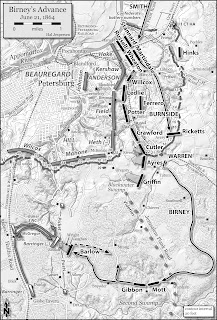
Hal Jespersen will soon transform my hen-scratching into one of his beautiful maps.  An example of his work (concerning II Corps' advance under Birney on June 21) follows.


Map by Hal Jespersen

I expect around 39 of them to grace the pages of my forthcoming book on the fighting around Petersburg from June 20, 20 July 1, 1864.  The text is finished except to accommodate what I learn from mapping, which so far has been fairly substantial.  A conservative estimate of a publication date would be two or three years more. 


Thursday, February 10, 2022

A Pleasant Evening at the Sarasota, Florida Civil War Round Table

Last Wednesday night, February 9, 2022, a pleasant time was had by all at the Sarasota, Florida Civil War Round Table.  We discussed Grant's fourth offensive at Petersburg described in my book, The Siege of Petersburg: The Battles for the Weldon Railroad, August 1864 (Savas Beatie, 2015), which is the second edition of The Destruction of the Weldon Railroad: Deep Bottom, Globe Tavern and Reams Station, August 14-25, 1864 (H. E. Howard, 1991).  

Some of us gathered after the meeting in front of the flags of the VFW post where we met.


The August battle at Globe Tavern, about six miles south of Petersburg (Globe Tavern was also called "Six Mile House") is also known as The Second Battle of the Weldon Railroad.  The late June fighting called the battle of Jerusalem Plank Road, which I'm writing about and mapping now, is also known as The First Battle of the Weldon Railroad.

What I remember most vividly about last night's talk was the relation between the late June and August fighting.  Brig. Gen. Francis Barlow and Maj. Gen. David Bell Birney never really got over the ambush sprung on the on June 22, 1864 by then Brig. Gen. William Mahone, whose Confederates employed a ravine and thick woods to outflank Barlow precipitating "Barlow's Skedaddle." Birney was Barlow's corps commander that day, and the Southerners rolled up the other two divisions of Birney's corps like a scroll.  As a result, on August 14 at Deep Bottom, when Barlow was ordered to leave uncovered the flank he exposed to the Confederates, he disobeyed orders and posted half his men on that flank and as a result had insufficient force to capture his objective; on August 15, Birney, then commanding X Corps, worried so much about fire off to his unprotected right that he failed to seize incomplete Confederate trenches guarding the Southern left.

Map by Hampton Newsome in The Petersburg Regiment in the Civil War: A History of the 12th Virginia Infantry from John Brown's Hanging to Appomattox, 1859-1864 (Savas Beatie, 2019), Winner of the 2019 Distinguished Writing Award in Unit History from the Army Historical Foundation

Sarasota is where I went to college from 1969 to 1973, but because of so much new construction I scarcely recognized the school when I took a spin up to it prior to the round table's meeting.

Wednesday, January 26, 2022

Sarasota, Florida Civil War Round Table 7 p.m., February 9, 2022: "The Battles for the Weldon Railroad, August 1864"

At 7 p.m. on Wednesday, February 9, 2022, I'll be at the Sarasota, Florida Civil War Round Table at VFW Post 3233 at 141 S. Tuttle in Sarasota for an in-person presentation about one of my books, The Siege of Petersburg: The Battles for the Weldon Railroad, August 1864 (Savas Beatie, 2015).

The title of my talk will be, "The Battles for the Weldon Railroad, August 1864."

The Weldon Railroad ran from Petersburg, Virginia to Weldon, North Carolina, where it connected with the port at Wilmington, North Carolina, and the Deep South.  Lee regarded it as indefensible but defended it successfully from the beginning of the Siege of Petersburg in June 1864 until the Federals severed it in August 1864.  The railroad is America's Railroad of Death not because of the deaths in battle in the fighting for the railroad, but because of the deaths among the approximately 9,000 Federal prisoners taken in the fighting.  More than half of them may have died of malnutrition and disease in Confederate prison camps. As many as 25 percent of the relatively few Confederate prisoners may have died in captivity at such places as "Hellmira" (Elmira, New York).

The Siege of Petersburg: The Battles for the Weldon Railroad, August 1864 covers one of Grant's most important offensives during the siege.  It forced Lee to recall forces on their way to Northern Virginia in an attempt to lift the siege by threatening Washington.

The late Edwin C. Bearss, former Chief Historian of the National Park Service, called my book The Siege of Petersburg: The Battles for the Weldon Railroad, August 1864 (Savas Beatie, 2015) "a superior piece of Civil War scholarship."  The dust jacket is based on a Keith Rocco painting depicting the 39th Illinois' charge at Fussell's Mill on August 16, 1864, in which its color bearer won a Medal of Honor and a battlefield commission.  The color bearer belonged to the 39th's Company G, the Preacher's Company, raised in part in Tinley Park, Illinois, where I have my law office.  I attended college in Sarasota, Florida from 1969 to 1973.


Map by Hampton Newsome

Saturday, January 15, 2022

The Weldon Railroad: America's Railway of Death

In The Gulag Archipelago, Alexander Solzhenitsyn wrote of the Salekhard-Igarka Railroad, which Stalin planned to run for about 1,000 miles above the Arctic Circle.  It came to be known as "the railroad of death," or the "dead road," and it was said that "beneath each tie two lie."  Political prisoners worked on the railroad in frigid winters and steamy summers.  A third of the prisoners are thought to have perished, between 40,000 and 100,000 dead.  The railroad was poorly constructed and never completed.

Destruction of Genl. Lee's Lines of Communication in Virginia (Library of Congress)

The closest thing to a railroad of death America has is the Weldon Railroad, officially the Petersburg Railroad, which ran from Petersburg, Virginia to Weldon, North Carolina, where it connected with lines leading to Wilmington, North Carolina as well as to the Deep South.  Lee wrote the Weldon Railroad off as indefensible as soon as the Federals arrived at Petersburg because the railway lay only a few miles beyond Northern lines.  Nonetheless, he successfully defended it for almost two months.

Deaths related to the Weldon Railroad stemmed from the fighting during the Siege of Petersburg during the summer of 1864.  The siege was the longest and bloodiest in American history, lasting 292 days.  Most of the casualties along the Weldon Railroad occurred during Grant's second offensive of the siege, June 20-July 1, 1864, and during his fourth offensive, August 18-21, 1864.  (He would launch nine offensives during the siege.)

The second offensive numbered among the widest-ranging and most ambitious of Grant’s offensives around Petersburg, ranging more than from White House Landing in the northeast to Staunton River Bridge in the southwest.  It ranked among the longest of his offensives around Petersburg, though not among the bloodiest.  The principal battles of Grant's second offensive were Jerusalem Plank Road (June 21-23) and Sappony Church/First Reams Station (June 28-29).  Including casualties from sharpshooting, skirmishing and shelling, the Federals in late June 1864 lost nearly 5,000 soldiers, including about 400 killed or mortally wounded and around 3,400 prisoners, and Confederate casualties approached 1,500 with approximately 200 killed or mortally wounded and 400 prisoners.


Map by Hampton Newsome

Losses during Grant’s fourth offensive, the deadliest of his nine offensives in proportion to the number of troops involved, were about 10,999 killed, wounded or missing among the Federals, and approximately 5,400 of about 56,795 Southerners present.  The fourth offensive's principal fights were (north of the James) Deep Bottom/Fussell's Mill (August 14-18) and (southside) Globe Tavern (August 18-21) and Second Reams Station (August 25).  Union killed, mortally wounded or prisoners in August for the campaign of 1864 were around 7,700, Confederate about 2,900. See Horn, The Battles for the Weldon Railroad, August 1864, 317-318.


Second Battle of Reams Station (Harper's Weekly)

Fighting along the Weldon Railroad was so lethal because so many of the casualties were prisoners.  More than half the approximately 9,400 Federal prisoners taken in late June and August may have perished.  See Cross, A Melancholy Affair on the Weldon Railroad, 177 (25 Vermonters killed or mortally wounded on June 23 and 407 captured of whom 226 died as prisoners).  The approximately 2,000 Confederate prisoners taken during late June and August probably did not fare too much better during their extended stay in beginning in late June and August due to Grant's policy of not exchanging prisoners during the 1864 campaign; Northern prison camps such as Elmira, New York ("Hellmira") may have had fatality rates of up to 25 percent. 

Thus the fighting for the Weldon Railroad may have resulted in the deaths of up to about 6,000 Federals and 2,000 Confederates.  Not many by Soviet standards, and we should be glad for that, but still the deadliest railroad in American history.  

Brief Bibliography

Cross, David Faris.  A Melancholy Affair on the Weldon Railroad: The Vermont Brigade, June 23, 1864.  Shippensburg, PA; White Mane, 2003.

Eanes, Greg.  Destroy the Junction: The Wilson-Kautz Raid and the Battle for the Staunton River Bridge.  Lynchburg, VA: H. E. Howard, Inc., 1999.

Horn, John.  The Siege of Petersburg: The Battles for the Weldon Railroad, August 1864.  El Dorado, CA: Savas Beatie, 2015.